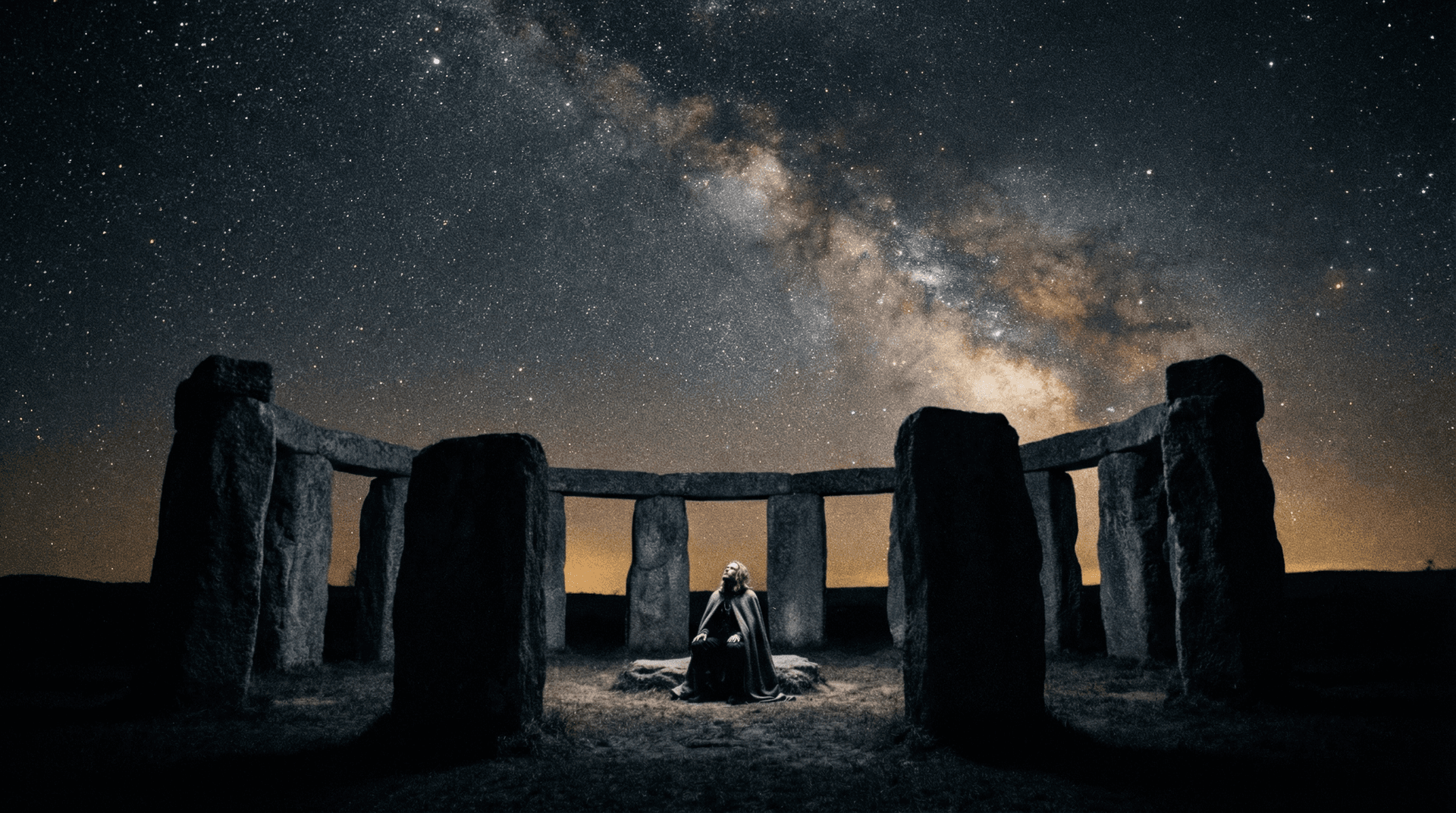
You notice the layer beneath what's being said. In a conversation, you're tracking the subtext. In a room, you're reading something most people aren't. You're drawn to ideas that haven't resolved yet, to questions that don't have clean answers. You feel more at home in ambiguity than in certainty, and you've been told that can be difficult to be around.
You've probably been described as intense. Possibly as hard to reach. People tend to feel seen by you in ways that surprise them, and then wonder why you've gone quiet.
What the Mystic pattern actually is
The Mystic pattern is organized around depth. Not complexity for its own sake, but the genuine perception that most experiences have a layer beneath what's visible, and that layer is where the real information lives.
Carl Jung's understanding of the mystic wasn't about mysticism in the religious sense. It was about the psyche's capacity to encounter what can't be fully named or systematized. The Mystic archetype is the personality organized around that capacity. It perceives pattern, symbol, undercurrent. It doesn't trust surface readings.
Find yours
Which pattern is running you right now — and what's the shadow it carries?
Take the free assessment →Free · 15 minutes · Full report $49
This pattern tends to develop in people who, early on, felt the gap between what was being said and what was actually happening. They learned to read the room at a level others didn't need to. The gift and the wound often arrive together.
The gift
When the Mystic pattern is working well, it produces perception that is genuinely rare. The ability to sense what's happening beneath the surface of a situation, before it becomes visible, before other people have language for it. This isn't intuition as vagueness. It's a specific kind of attunement that takes in more information than most cognitive systems are tracking.
The Mystic can hold uncertainty without collapsing toward premature resolution. Where others need a conclusion to function, this pattern can remain with the open question and let it develop. That capacity produces depth in writing, in conversation, in creative work. It produces the kind of insight that makes people feel understood at an unusual register.
Work done from this pattern tends to go somewhere most work doesn't. It makes room for complexity. It doesn't flatten.
The shadow: The Ghost
The shadow archetype of the Mystic is the Ghost.
The Ghost emerges when depth is not met. When the Mystic offers genuine perception and it lands on indifference, or is simplified into something more palatable, or is received without real recognition. The response is withdrawal. Quiet disappearance. A slow pulling back from visibility.
It's a rational response to repeated misunderstanding. The problem is that the withdrawal becomes a habit, then a default, then a structure. The Ghost is absent from relationships at the moments when presence would matter most. Absent from work when visibility is required. Absent from its own life, observing from a distance rather than inhabiting.
The Mystic in Ghost mode can describe what's happening in the room with precision. They just won't be fully in the room when they're describing it.
The wound beneath the Ghost is this: depth has not been worth the exposure. Showing the full range of perception has created more isolation than connection. So the pattern contracts. Goes underground. Waits to be seen without risking being seen. The Mystic's Ghost pattern maps this dynamic in detail, including how it operates differently at each stage of the Mystic's development.
How this pattern shows up in work and creative life
The Mystic pattern thrives in any domain that rewards depth perception. Therapy, spiritual direction, depth psychology, research that goes somewhere other researchers won't. Writing that operates on multiple registers at once. Philosophy that doesn't stop at the first coherent answer.
The Healer archetype often appears in similar vocational territory. The difference is in the primary gift: the Healer's is attunement to others' emotional and psychological processes; the Mystic's is perception of what lies beneath the surface of a situation. Both are depth-oriented patterns, but the shadow forms in different directions. The Healer's shadow tends toward enablement and self-erasure. The Mystic's tends toward disappearance.
In business and creative work, this pattern produces content and ideas that others catch up to years later. The Mystic builds audiences that are small but deeply loyal, because depth attracts depth. A room of a hundred people who are genuinely moved is more aligned with this pattern than a platform of ten thousand casually engaged. For the practical question of how to monetize spiritual gifts without flattening what the Mystic offers, the structure usually matters more than the marketing.
The friction tends to come with visibility. The Mystic can do exceptional work and then refuse to promote it, or pull back from an audience that's growing, or find reasons to make their work harder to access. The Ghost is usually present in that friction. This is also where spiritual bypassing tends to show up: calling the withdrawal practice, framing unavailability as integrity, using the language of depth to protect against the exposure that depth actually requires.
Work that requires staying shallow exhausts this pattern quickly. Trending content, surface engagement, the performance of certainty, these are misalignments that register as physical drain.
The integration question
Integration for the Mystic doesn't mean becoming comfortable with being misunderstood. It means learning to offer depth without requiring it to be received at full resolution.
The Ghost forms because the Mystic has learned, usually through repeated experience, that depth not received is the same as depth rejected. Integration involves separating those two things. Something can be offered, partially received, and still have been worth the offer. Visibility can be sustained even when the depth isn't perfectly met, because the alternative, disappearing, forecloses all the connections that are possible.
The behavioral marker of integration is this: staying in the room. Staying visible in the work. Continuing to publish, to speak, to be present even when the response doesn't match the depth of what was offered. The Ghost dissolves not by being exorcised but by being made unnecessary.
The shadow work exercises most useful for the Mystic tend to center on deliberate visibility: publishing before the work feels ready at full resolution, naming the perception in writing even when it can't be perfectly articulated. The practice is staying present, not achieving perfect transmission.
The container for that staying often looks closer to a guidance business than a conventional coaching practice. The form needs to hold depth without requiring it to be performed.
When the Mystic can stay present without requiring perfect reception, the depth becomes available to people who are ready for it. And those people do exist.
What is the mystic archetype?
The mystic archetype is the Jungian pattern organized around depth perception — the capacity to sense the layer beneath the surface of events, relationships, and ideas. People living this pattern are drawn to meaning, ambiguity, and unseen dimensions of experience. They tend to perceive what others miss and find shallow engagement genuinely difficult to sustain.
What is the mystic archetype shadow?
The shadow of the mystic archetype is the Ghost. When the Mystic's perception goes unreceived or unrecognized, the shadow response is withdrawal. The Ghost disappears from relationships, from visibility, from work, becoming absent exactly when presence is most needed. It's a protective pattern that becomes a trap.
What does the mystic archetype mean in Jungian psychology?
In Jungian psychology, the mystic archetype represents the psyche's orientation toward depth and the unconscious. It carries the capacity for perception beyond the rational surface. Jung understood this pattern as essential but potentially isolating, because depth that can't find a receiver tends to turn inward. The work is keeping the perception active and the presence intact. To explore all 12 Jungian archetypes and how they relate, the full framework maps each pattern against its shadow. For a deeper exploration of this archetype's full range and how the Ghost forms, see The Mystic Archetype Meaning.
The only way to know your alchetype — and the shadow it carries — is to take the assessment.