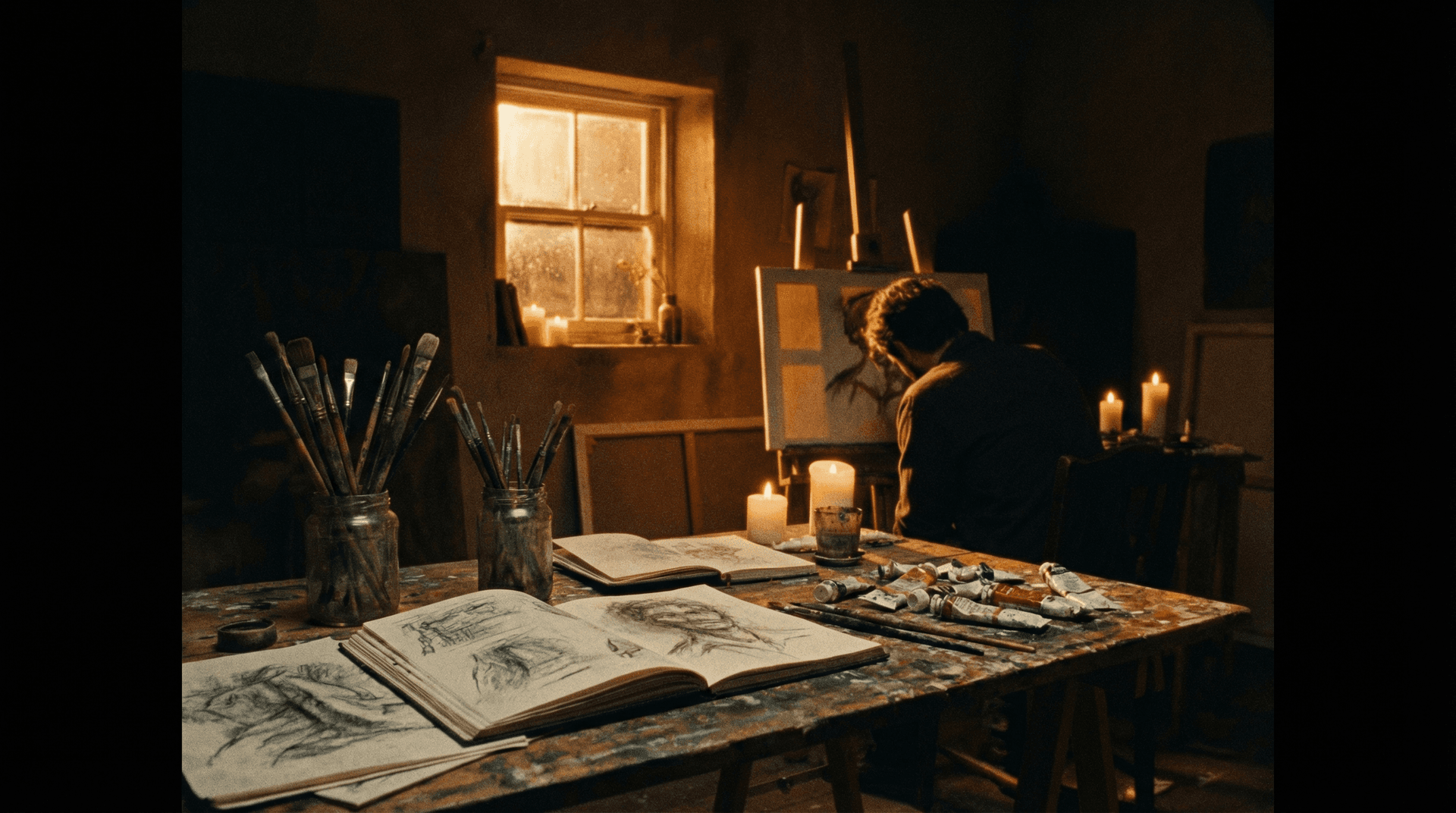
You're not comfortable when you're not making something. The absence of a project feels like a kind of wrongness, an ambient restlessness that's hard to describe to people who don't experience it. You don't need it to be recognized. You need it to exist.
You've made things no one will ever see. You've made things that took years and were abandoned inches from completion. You've made things that worked and then immediately started wondering what came next.
The making is the thing. Whether the made thing survives is a separate question.
What the Creator pattern actually is
The Creator pattern is organized around production. The specific drive to bring things into existence that weren't there before: objects, writing, systems, experiences, software. Things that required the Creator's particular perception and hand to become real.
Find yours
Which pattern is running you right now — and what's the shadow it carries?
Take the free assessment →Free · 15 minutes · Full report $49
This is different from skill. Skilled people can execute well within existing forms. The Creator is oriented toward making new forms. They have a relationship with craft and with the specific materials they work with, and that relationship has its own texture, its own history, its own ongoing conversation.
Jung identified what he called the constructive function of the psyche as the capacity to generate rather than adapt. The Creator archetype carries this as a dominant drive. The world is something to add to, not just navigate.
The gift
When the Creator pattern is working well, it produces genuine original work. Things that are specific, that couldn't have been made by anyone else in the same way, that carry a perspective rather than a consensus.
The Creator has a relationship with their materials that shows in the work. The writer who knows what a sentence can hold. The designer who knows what an image can carry. The developer who knows what a system can do. That knowledge comes from sustained attention over time, and it produces work that reflects it.
This pattern also produces momentum in creative communities. Creators tend to inspire other creators. Their output creates permission for others to make.
The shadow: The Hoarder
The shadow archetype of the Creator is the Hoarder.
The Hoarder accumulates. The drafts folder is full. The projects folder has seventeen subdirectories. The notebooks are stacked. Everything is in progress and very little is complete.
Perfectionism is the Hoarder's most sophisticated strategy. The work isn't ready. There's one more revision, one more element, one thing that needs to be right before it can go out. The standard keeps moving. The release date keeps sliding. The work stays private and therefore stays safe.
Safe from being seen as insufficient. Safe from being received wrong. Safe from the specific grief of completing something and discovering it doesn't have the effect you hoped. As long as the work isn't out, it's still possible that it will be everything.
The Hoarder also accumulates starts. Each new beginning carries the energy of possibility, before the friction of the middle arrives. The Creator in shadow mode can have twenty first chapters and no books.
How this pattern shows up in work and creative life
The Creator pattern is most naturally aligned with any work that produces made things. Writing, visual art, music, software, product design, film, content. Work where the primary output is an artifact that didn't exist before.
In business, this pattern tends to produce exceptional work and difficult release. The Creator can be hard to move to launch. They often need a structure or a collaborator who functions as the external permission to finish, because the internal permission is always conditional.
Content made from this pattern has a quality of craft. It's specific. It doesn't feel generic. The Creator's audience can feel the attention that went into the work, and that builds loyalty over time.
The friction is volume. The Creator often makes more than they release. The ratio is the shadow in numerical form.
The integration question
Integration for the Creator is the recognition that releasing is part of the creative act. Completion is its own form of making. The thing that goes into the world and does its work there is more real than the thing that stays in the drafts folder, no matter how perfect the draft version is.
The behavioral marker: the integrated Creator can ship something knowing it isn't everything they wanted it to be and feel the satisfaction of the offering rather than only the compromise. They can close a project. They can put a date on something and hold it. They can let the work be received.
The Hoarder doesn't disappear. The perfectionist impulse remains part of the pattern. Integration means it becomes one voice among several, not the final authority. The work gets out. That's the whole game.
The practical starting point is often one thing released rather than perfected. Shadow work exercises built around the Creator pattern focus on exactly that threshold: the internal gap between finishing and letting go.
The Creator alongside related patterns
Several alchetypes carry a strong relationship to making. Understanding how the Creator pattern differs from them matters for reading a result accurately.
The Storyteller archetype also produces. The difference is in the relationship to audience. The Storyteller makes things to be witnessed — the narrative impulse is social, pointed outward toward reception. The Creator makes because the making itself is necessary, regardless of who's watching. The Storyteller's shadow involves performance and escape. The Creator's shadow involves hoarding. Both patterns produce exceptional work. The orientation is different.
The Visionary archetype generates in a different register. The Visionary sees what could exist; the Creator brings it into being. Many people carry both patterns at different levels of dominance. When the Visionary is primary, the work stalls in the realm of possibility. When the Creator is primary, there's real output — the friction is release, not generation.
The Alchemist archetype transforms. Where the Creator adds to the world, the Alchemist changes what's already there. The Alchemist tends to work with existing material: relationships, systems, people's understanding of something. The Creator tends to start from absence — the blank page, the empty canvas, the problem nobody has built a solution for yet.
None of these distinctions are rigid. Patterns layer. But knowing which one is dominant tells you where the friction most likely lives, and which shadow expression to look for first.
FAQ
What is the creator archetype?
The creator archetype is the Jungian pattern organized around making. People living this pattern generate original work, have a genuine relationship with their craft and materials, and bring things into existence that require their specific perception to become real. The drive to make is central to their identity.
What is the creator archetype shadow?
The shadow of the creator archetype is the Hoarder. The Hoarder accumulates starts and drafts without completing or releasing them. Perfectionism functions as a form of hoarding: the work stays private because private work can't be judged, rejected, or received wrong. The ratio of made things to released things is the shadow in visible form.
What does the creator archetype mean in Jungian psychology?
In Jungian psychology, the creator archetype connects to the constructive function of the psyche — the capacity to generate new forms. Jung distinguished between the adaptive function, which navigates existing structures, and the constructive function, which builds new ones. The shadow emerges when the generative drive accumulates inward rather than producing outward. Explore the 12 Jungian archetypes to understand how each pattern carries its own version of this tension. For the full scope of how the Creator pattern develops across a life and work, see The Creator Archetype Meaning.
The only way to know your alchetype — and the shadow it carries — is to take the assessment.