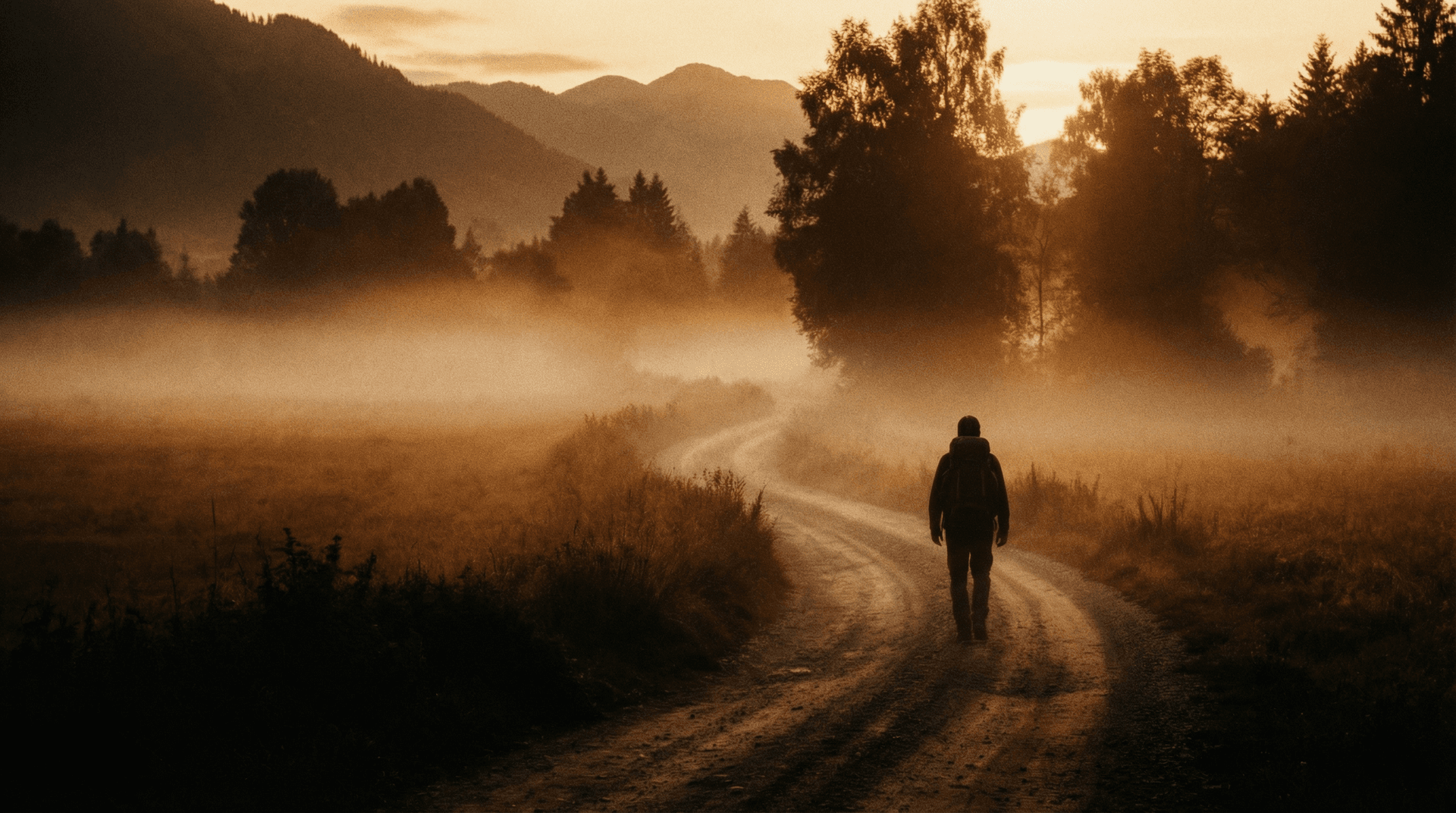
You've been places most people in your network haven't been. Not necessarily geographic places, though maybe that too. More specifically: you've spent time in territories that require leaving the familiar behind, and you've come back with things. Perspectives. Material. A particular kind of knowledge that only accumulates in motion.
New contexts energize you in a way that's hard to explain to people who find them destabilizing. The unfamiliar isn't threatening. It's interesting.
The question underneath: is there a home?
What the Adventurer pattern actually is
The Adventurer pattern is organized around the unknown. The specific capacity to move toward unfamiliar territory with genuine openness rather than defensive preparation. To adapt. To take in what's different rather than filtering it through what's familiar.
Find yours
Which pattern is running you right now — and what's the shadow it carries?
Take the free assessment →Free · 15 minutes · Full report $49
Jung mapped the tension between the call to adventure and the return as one of the central dynamics of psychological development. The outward movement is necessary. It's how new material enters. The Adventurer archetype is the personality organized primarily around that outward movement.
This isn't restlessness for its own sake. The Adventurer has a genuine relationship with discovery. They're drawn to what they don't yet know because they've learned, through experience, that the unknown contains things the known doesn't.
The gift
When the Adventurer pattern is working well, it produces access. The Adventurer has been somewhere others haven't been and can bring back what's there. This shows up in research that goes to unexpected places, in creative work that draws on unlikely sources, in consulting that brings external perspective into insular systems.
The Adventurer also adapts well to new contexts. They can read an unfamiliar environment quickly, find their footing, and become useful. In early-stage ventures, in new markets, in any situation where the familiar playbook doesn't apply, this capacity is rare and valuable.
Content made from this pattern has a quality of discovery. The Adventurer explores rather than explains. Their audience follows them somewhere rather than just receiving information.
The shadow: The Runaway
The shadow archetype of the Adventurer is the Runaway.
The Runaway uses movement as escape. The next project replaces the current one before the current one is finished. The next relationship offers what the current one has stopped offering, which is novelty and the sense of possibility before the complications arrive. The next city, the next role, the next version of the work.
The Runaway has learned to recognize the feeling of depth approaching and to move before it arrives. Depth requires staying. Staying requires tolerating the friction of sustained engagement. The Adventurer in shadow mode experiences that friction as a sign that something is wrong, as a signal that it's time to move, when it might actually be a sign that something real is beginning.
Mastery in any domain requires staying past the point of initial excitement. The Runaway never gets there. It has a collection of beginnings and the residue of things that could have developed into something more.
How this pattern shows up in work and creative life
The Adventurer pattern is suited to travel, research, early-stage consulting, any role that requires covering new territory and reporting back. The pattern thrives in roles that are explicitly about exploration, where the expectation is movement rather than depth.
The friction arrives in middle stages. Any project, relationship, or body of work has an initial phase of discovery and then a longer phase of depth development. The Adventurer excels at the first. The shadow can short-circuit the second.
In business, this pattern often produces serial entrepreneurs, prolific but scattered creative output, and a portfolio of almost-things. There's significant overlap here with the Creator archetype, which faces a different version of the same problem: the hoard of unfinished things. The pattern is most successful when it can find a form that sustains genuine discovery over time, rather than requiring new starts to feel alive.
The Adventurer and the multipotentialite question
There's a significant overlap worth naming. People who identify as multipotentialites, drawn to many fields, resistant to committing to a single specialization, often carry the Adventurer pattern as their primary or secondary archetype.
The overlap is real, but the framing matters. Multipotentialite is a description of behavior. The Adventurer is the pattern underneath, the reason behind the behavior. That distinction changes what you do with it.
Multipotentialite business approaches often try to find a form that accommodates the movement: portfolio careers, multi-offering businesses, roles that permit context-switching. That can work. What it can't resolve is whether the movement is genuine exploration or the Runaway shadow in professional clothing.
The Adventurer who builds a business around their mobility often discovers that the business, once it's working, requires the same thing as any sustained endeavor: presence, depth, the willingness to stay through the friction of the middle. A portfolio business doesn't exempt you from the Runaway. It just gives it more options.
Shadow work integration for the Adventurer pattern often starts at the moment a domain or project stops being new. Most people experience this as the work getting harder, less interesting, harder to show up for. The Runaway reads this as a signal to move. But that feeling is often just the initial phase ending. What comes after, if you stay, is usually more complex and more valuable than another beginning.
The Adventurer's real strength isn't in starting. It's in what they notice when they finally arrive somewhere and stay long enough to see what's actually there.
The integration question
The Adventurer often finds natural kinship with the Rebel archetype — both patterns carry an aversion to stasis, and both can mistake the pull to stay as a threat to their identity. The distinction is that the Rebel resists authority; the Adventurer resists arrival. Knowing which pattern is primary changes the integration work considerably.
Integration for the Adventurer is the recognition that exploration can happen within depth as much as across surface. That staying in one place, one relationship, one body of work long enough to encounter its real complexity is its own form of discovery. The unknown is inside the known thing, if you stay long enough.
The behavioral marker: the integrated Adventurer can be somewhere for a year and still find it interesting. They can push through the friction of the middle of a project and discover that what's on the other side is more interesting than the beginning was. They can feel the pull to move and sit with it as information rather than instruction.
Exploration becomes a choice rather than a compulsion. And when it's a choice, it's actually more adventurous, because the Adventurer is present for what they find.
What is the adventurer archetype?
The adventurer archetype is the Jungian pattern organized around exploration and genuine openness to the unknown. People living this pattern adapt fluidly to new contexts, move toward what they don't yet understand, and bring back material from territories others haven't visited. The gift is access. The shadow is that the movement never stops long enough to become depth.
What is the adventurer archetype shadow?
The shadow of the adventurer archetype is the Runaway. The Runaway uses movement as a way of avoiding the depth that would develop if they stayed. Projects, relationships, and creative work get abandoned at the threshold of real development. Mastery requires staying, and staying feels like dying.
What does the adventurer archetype mean in Jungian psychology?
In Jungian psychology, the adventurer archetype embodies the necessary outward movement of psychological development — the capacity to leave the known and encounter what's on the other side. Jung saw this as essential. The shadow emerges when the outward movement becomes permanent, when the return is perpetually deferred. The Adventurer who never comes home never integrates what they found. The 12 Jungian archetypes each map this tension between gift and shadow.
The only way to know your alchetype — and the shadow it carries — is to take the assessment.